guide
How to Play Pin Rescue: Safe Orders and Common Mistakes
Learn how to read hazards, predict gravity, choose a safe pin order, and recover quickly from failed sequences in Pin Rescue.
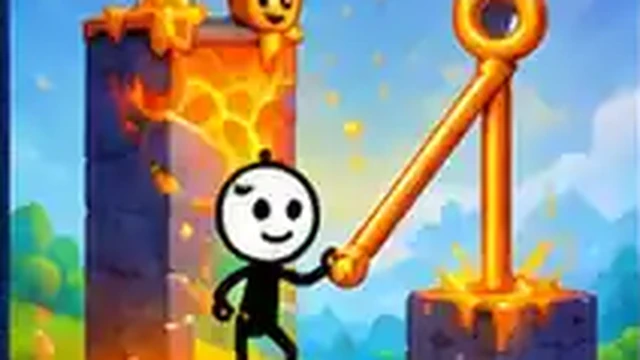
Pin Rescue is an order-of-operations puzzle disguised as a set of simple pin pulls. The controls are intentionally small: tap or click a removable pin, watch the scene resolve, then choose the next action. The challenge is deciding which consequence must happen first. Open Pin Rescue beside this guide if you want to apply each idea to a live puzzle.
Read the whole room before touching the first pin
The fastest way to lose is to treat the closest pin as the obvious first move. Instead, trace every object that can move. Ask three questions before acting:
- What begins moving when this pin disappears?
- Where can that object travel under gravity?
- Will the hero still be protected after that movement finishes?
If a pin releases lava, water, an enemy, treasure, or the hero into a new chamber, the important information is not the pin itself. It is the path that opens behind it.
Resolve irreversible danger before optional progress
Some actions are easy to recover from and some are not. Releasing a hazard into the hero’s route is usually irreversible. Moving treasure closer to the hero may be useful, but it is not useful if the same action leaves an active danger above the route.
When two pulls both look plausible, prefer the one that makes the scene safer. A good sequence often removes or neutralizes the dangerous interaction first, then releases the hero or reward after the path has become stable.
Let gravity finish before planning the next move
After a pull, watch the full consequence. Do not mentally jump straight to the next pin while an object is still falling or a chamber is still changing. The board state after the motion stops is the state you should use for the next decision.
This sounds slow, but it actually speeds up solving. One careful observation is cheaper than restarting because you planned against a scene that no longer exists.
Use failed attempts as information
A failed sequence should remove possibilities from your mental search tree. If pulling pin A first sends a hazard into the hero, the next attempt should not be “A again but faster.” It should test the action that changes that hazard path before A is touched.
A simple method is to remember only the first wrong decision. You do not need to memorize the entire failed run. Restart, change that first irreversible mistake, then continue from the new state. That keeps the puzzle readable even when several pins are visible.
Common mistakes
Releasing the hero too early. The exit may look reachable, but a moving hazard can cross the same route a moment later. Secure the route first.
Treating water and lava as independent. When two materials can interact, their order matters. Think about where each one will settle before opening both paths.
Ignoring locked or safety pins. Not every visible pin is meant to be removed immediately. A non-removable element is part of the puzzle’s constraints, not a broken control.
Using a hint without reading the result. A hint is most useful when it teaches why a move is safe. After seeing the suggested move, identify the hazard or path it resolves so you can recognize the same pattern later.
A reliable solving routine
For each new room, identify the hero, the goal, every hazard, and every object whose motion can change the route. Mark the most dangerous irreversible interaction. Find the pin that neutralizes or redirects that interaction, then simulate the result mentally. Pull only when the resulting board still contains a safe path to the goal.
That routine turns a guessing game into a compact reasoning puzzle. The levels are short enough that you can retry immediately, but a deliberate first move usually saves more time than fast tapping.
What to play next
For another rescue mechanic, Draw Rescue replaces pin order with one protective line and a physics simulation. Ricochet Rescue turns prediction into bank-shot geometry. You can browse all BopBits games when you want a different short puzzle or arcade loop.