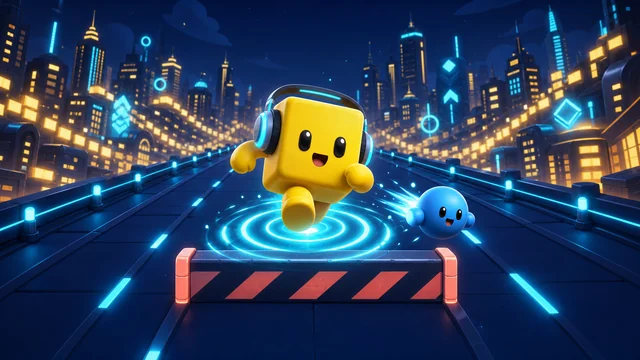
What to notice on your first run
Bop Dash uses familiar runner actions: change lanes around solid crates, hop barriers,
slide below low signs, and spend a charged dash to break marked obstacles. The pulse adds
score and city light when an action lands within 90 milliseconds of the beat. An off-beat
move performs the same hop, slide, or lane change, so rhythm never becomes a hidden fail
condition.
Every action now has a readable motion arc: Bop compresses before takeoff, separates from
the ground shadow in the air, lands with a short recovery, banks into lane changes, and
leans into dash speed. Pickups, boosts, shield saves, and collisions each have their own
event-timed response, so the feedback explains what happened without changing the hitbox.
Why this mechanic works in a short session
The simulation gives each new obstacle at least 1.08 seconds of warning, comfortably
above the game’s 450-millisecond fairness floor. Only one blocking obstacle is introduced
at a time, lane silhouettes remain visible against all three backgrounds, and cyan sparks
are placed away from the immediate threat so collecting them is a choice rather than a
trap.
Forty-five missions across the night city
The first 15 missions cross warm rooftops, the next 15 enter a neon market, and the final
15 climb the skyline rail. Goals combine distance, safe beat hits, and collected sparks.
Progress, best score, best distance, and earned mission position save locally so a browser
refresh does not erase the campaign.