What to notice on your first run
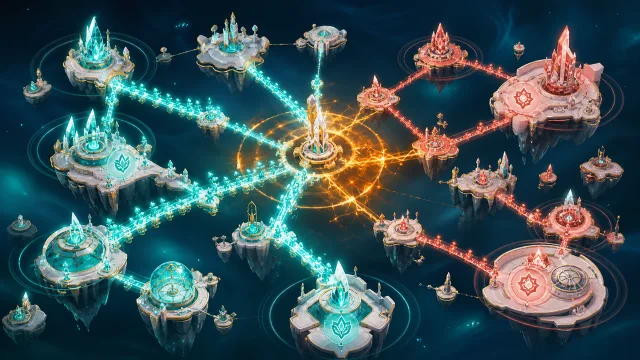
The command interface keeps the current shift, relay shield, Flux and next enemy group in one fixed band. On the field, every legal socket is tied to the painted route and every selected defender exposes its useful range before placement. The goal is to make the tactical picture readable before the first wave moves.
Why this mechanic works in a short session
Each of the four shifts adds pressure without replacing the rules you already learned. Defender roles stay visually distinct, forecasts reduce guesswork, and deterministic waves let a failed layout become useful information. A restart is an invitation to change one meaningful decision rather than repeat a hidden dice roll.
Build a resonant defense
Helio Needle provides efficient early coverage, Tidelight Prism controls crowded lanes, Umbra Well punishes clustered enemies, Mosswright extends the defensive rhythm and Zenith Array offers an expensive late-field anchor. Their values come from where their ranges overlap the route, not from stacking icons into every available socket.
Designed for the GameHub player
Lumen Bastion keeps its native portrait playfield inside the wider BopBits desktop stage, while phone layouts switch the stage to a taller 3:4 frame. Fullscreen remains available when you want the field to use the entire display.
Tower defense strategy for the four shifts
Treat each forecast as a placement question rather than a prompt to fill every socket. Cover the longest bend first, add control where groups overlap, and keep enough Flux to answer the next enemy mix. The Lumen Bastion tower defense strategy guide explains a four-shift planning routine using the visible forecast, range preview, Flux budget, and relay shield.
For a faster strategy match built around temporary routes instead of fixed defenders, try Signal Frontiers or browse the BopBits strategy games hub.