What to notice on your first run
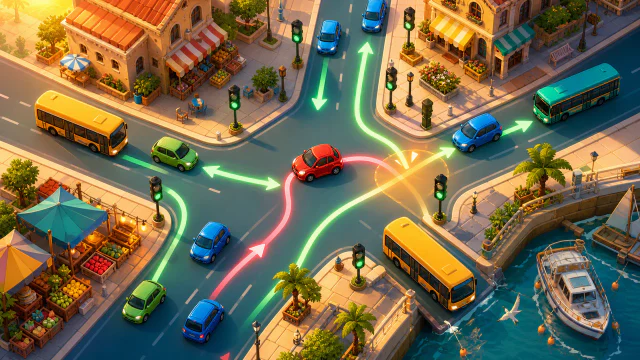
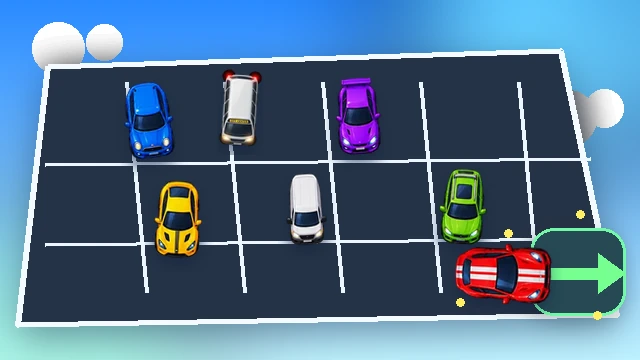
Classic preserves the original sliding-car campaign: inspect the 6×6 grid, move cars only along their orientation, and open the exit row with as few committed drags as possible. Escape Flow changes the decision from position to timing. Each roof symbol has a visible path across the junction; once released, the vehicle follows that route automatically.
The important Flow information is the shared conflict zone. Hold or focus a waiting vehicle to make its path solid, compare it with cars already moving, and release only when their occupancy windows will not overlap. A collision freezes immediately and highlights both routes, so failure remains explainable rather than random.
Why this mechanic works in a short session
The 32 launch junctions are split evenly across School Run, Market Grid, Harbor Loop, and Neon Junction. Later districts add longer vehicles, mixed speed classes, turning routes, and larger Signal Chain targets. Every shipped route has an automated collision-free proof schedule and replays at a fixed 60 simulation ticks per second independently of rendering frame rate.
Signal Chain, Daily Junction, and fair retries
Signal Chain grows when you release another safe vehicle before the previous route leaves its final conflict zone. It contributes to mastery stars but never changes collision geometry or blocks progression. Daily Junction selects the same proof-validated level for everyone by UTC date and gives it a stable share code. Practice and instant retry are unlimited; ads are confined to explicit hints or recovery and completed-level breaks on supported hosts.
Accessibility and keyboard play
Vehicle roof symbols supplement color, every waiting vehicle is a real focusable control, and route previews have distinct dotted, solid, and conflict treatments. Escape Flow supports keyboard selection and release, system reduced-motion preferences, clear live status messages, and immediate restart without requiring precision steering.
Two ways to solve a traffic escape
Traffic Tangle asks whether a vehicle can move safely through a shared route or slide out of a packed grid. Parking Escape removes timing pressure and focuses on which car already has a clear lane to the edge. Compare both in the traffic puzzle games collection to choose between route timing and parking-lot order.